Digital Product Roadmaps: How UK SMEs Can Invest Without Overbuilding
A useful SME roadmap stages digital investment around outcomes, evidence, dependencies, adoption and operational capacity instead of a fixed feature backlog.
Muhammad YaseenFounder
01 Nov 202610 min read00
On this page
A digital product roadmap should help an SME decide where to invest next, not lock the business into a long feature list.
For UK SMEs, that distinction matters because digital adoption is rarely constrained by ideas alone. The harder constraints are often time, cash, implementation confidence, switching risk, staff capacity and uncertainty about whether a proposed tool will improve a customer or operational outcome.
Current UK evidence supports that picture. The Department for Business and Trade's research on SME technology adoption describes adoption as a journey rather than a single purchase and highlights the value of reliable, personalised support. The SME Digital Adoption Taskforce report also identifies high switching and adoption costs, gaps in expertise and execution support, and fragmented support as barriers.
A useful roadmap therefore does three things:
starts with measurable business capabilities or customer outcomes;
stages investment according to evidence, dependencies and operational readiness;
keeps flexibility to stop, change or delay work when the evidence changes.
This guide is for UK SME owners and leaders planning digital investment across products, internal systems or customer-facing services. It is strategic planning guidance, not financial advice.
A roadmap is a decision system, not a delivery promise
A roadmap is often treated as a schedule with features attached to months.
That can be dangerous because the farther into the future the plan goes, the less the organisation knows about customer behaviour, implementation effort, adoption and commercial return.
Build with FlutterCraft
Plan digital investment around outcomes, not feature volume
Explore FlutterCraft's product and digital services, or join the newsletter for practical planning frameworks.
Muhammad Yaseen is the Founder of FlutterCraft. He writes for founders and business leaders making high-stakes decisions about MVPs, digital investment, development partners, product validation, and sustainable growth.
Related articles
Continue with more FlutterCraft thinking for founders and product teams.
The GOV.UK Service Manual recommends roadmaps that capture intent, remain easy to adjust as priorities change, and make clear both what the team is doing and what it is not doing. That is a stronger model for SME digital investment than a fixed multi-year backlog.
A good roadmap answers four questions:
What outcome are we trying to improve?
What must be true before the next investment is sensible?
What evidence will change our decision?
What are we deliberately not doing yet?
The last question protects cash and focus.
Start with outcomes, not software categories
“Implement CRM”, “build an app” or “add AI” are not outcomes. They are possible solutions.
Start by describing the business capability that needs to improve.
Weak roadmap item
Better outcome statement
Buy a CRM
Reduce lost follow-ups and give the sales team one reliable customer history
Build a customer app
Let repeat customers complete the highest-value service journey without staff intervention
Add automation
Remove repeated manual re-entry between two operational systems
Add analytics
Give managers a weekly view of the few measures used to make product and commercial decisions
Introduce AI
Shorten a defined task while preserving review, privacy and quality controls
This matters because the solution may change while the outcome remains valid.
A business that starts with “build an app” can become attached to a large custom project before testing whether a responsive web flow, better integration or process redesign would solve the problem more cheaply.
A roadmap becomes realistic when it includes the constraints that can make adoption fail.
Data readiness
Does the organisation have usable data, clear ownership and a reliable way to move it into the new process?
A new system built on duplicated or inconsistent data can create a more expensive problem than the one it replaces.
Integration dependencies
Which existing systems must connect to the change?
An apparently small customer-facing improvement may depend on finance, inventory, identity, scheduling or supplier data.
Staff capacity
Who will configure, test, learn, support and own the change after launch?
Technology adoption is not complete when a vendor account is created or software is deployed.
Process readiness
If the current process is unclear, software can automate ambiguity rather than remove it.
Write the current workflow first. Identify what should be removed, standardised or measured before digitising it.
Switching and continuity risk
The SME Digital Adoption Taskforce notes concerns about lock-in, switching costs and data portability. Those issues should appear in roadmap decisions before an organisation becomes dependent on a platform.
Ask how data can be exported, what happens at contract exit, which integrations are portable and how long parallel operation may be required.
Security, privacy and operational risk
Some roadmap items increase access to personal information, business-critical systems or customer transactions.
Those changes need proportionate risk review rather than being treated as ordinary feature work.
Use a now-next-later investment structure
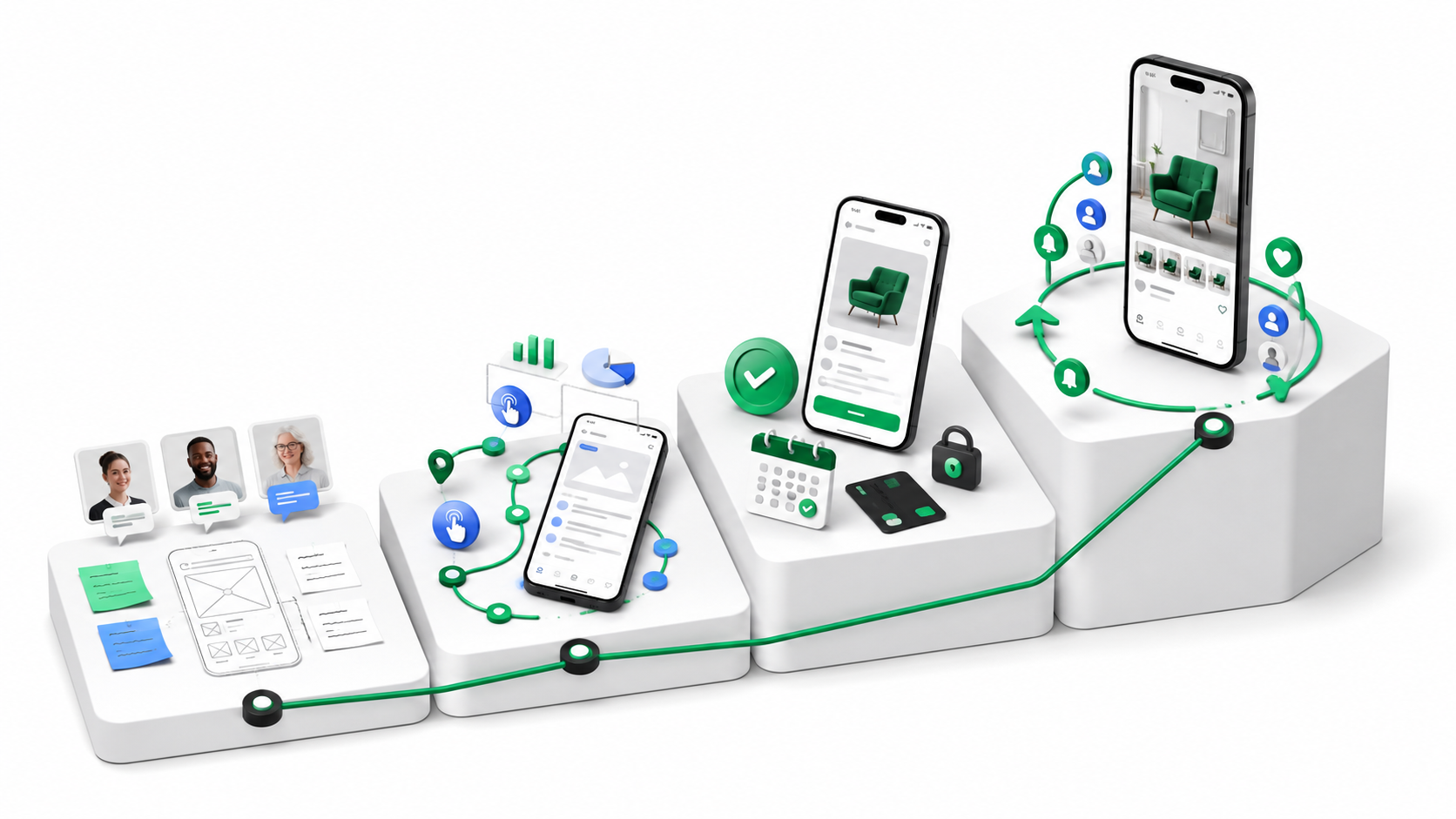
A now-next-later roadmap communicates priority without pretending distant work is fully specified.
Now: remove a proven constraint
The “now” section should be small.
Choose work where the problem is well evidenced and the organisation is ready to act. Examples include:
consolidating customer records before a new sales workflow;
integrating two systems that currently require manual re-entry;
improving an existing online journey with clear abandonment evidence;
running a tightly scoped pilot for an uncertain capability.
The key is that “now” is not simply whatever was requested first.
Next: prepare the next capability
“Next” includes work that appears valuable but depends on learning, adoption or infrastructure.
Examples include preparing clean product data before customer self-service, testing one automation before standardising it across teams, validating a workflow with one location before wider rollout, and establishing staff ownership before increasing complexity.
This is where small pilots are useful.
The SME Digital Adoption Taskforce final report recommends a test-and-learn approach: pilot interventions, measure outcomes and adjust based on evidence and SME feedback. That principle works inside an individual business too.
Later: preserve options rather than promises
“Later” should describe capability themes rather than detailed specifications.
Examples include expanding self-service to more journeys, connecting customer and operational data, introducing forecasting once underlying data is reliable, and opening partner integrations after internal ownership is stable.
The farther into the future the roadmap goes, the more its language should communicate uncertainty.
Prioritise opportunities with four dimensions
A simple SME roadmap scoring aid is:
Value × evidence ÷ (effort × risk)
This is an editorial decision tool, not a validated financial forecast.
Value
What business or customer outcome could improve? Consider revenue opportunity, time saved, error reduction, service quality, customer access or strategic capability.
Evidence
How confident are you that this problem matters? Evidence could include repeated customer behaviour, operational records, staff observations, support demand, sales friction or pilot results.
Effort
Consider implementation, integration, migration, training, support and ongoing maintenance, not just build cost.
Risk
Consider adoption, data, security, supplier dependency, business continuity and uncertainty.
A high-value idea with weak evidence may deserve a pilot rather than a full build. A medium-value item with strong evidence and low effort may deserve earlier investment.
Add decision gates between investments
A roadmap becomes safer when each stage has a gate.
Gate 1: problem evidence
Can we show the problem occurs often enough to justify change?
Gate 2: solution evidence
Has a small test shown the proposed approach improves the intended outcome?
Gate 3: operational readiness
Is there an owner, support process, training plan and realistic capacity for adoption?
Gate 4: scale evidence
Does the result still hold when volume, teams or customer segments increase?
These gates prevent a common pattern: successful pilot, immediate full rollout, hidden operational cost.
Fund the work around the product, not only the product
A roadmap budget that only includes software delivery is incomplete.
Digital investment also creates costs in:
migration and data clean-up;
training and change management;
support and administration;
security and privacy work;
integration maintenance;
analytics and measurement;
vendor management;
documentation;
ongoing product maintenance.
These costs are not equal for every initiative, but the roadmap should make them visible.
The 2025 Taskforce report identifies time, cash, know-how, implementation support and switching risk among barriers faced by smaller firms. A roadmap that ignores these constraints can look affordable on paper and still fail in practice.
Protect operational capacity
An SME cannot transform every workflow at once without creating change overload.
For each roadmap quarter, ask:
How many teams are affected?
Who handles day-to-day delivery while the change happens?
What training or process changes are required?
What other operational events are already planned?
What must remain stable while the capability is introduced?
The answer may lead to fewer concurrent initiatives. That is a way to protect implementation quality rather than a sign of low ambition.
A quarterly roadmap review template
Review the roadmap every quarter, or sooner when a major assumption changes.
Outcome review
For each investment, ask what it was meant to improve, what evidence changed, whether the measure moved, and whether another factor may explain the result.
Avoid forcing attribution when the evidence is weak.
Adoption review
Are intended users actually using the capability? Where do people return to manual work? Which support requests repeat? Does the process work without one expert constantly intervening?
Cost and effort review
What ongoing work appeared after launch? Which integrations or suppliers require more attention than expected? What maintenance should now be included?
Dependency review
Did data, process or supplier assumptions change? Does a “next” item need enabling work first? Can any planned work be removed because another solution now exists?
Portfolio decision
Move each item into one of five states:
continue;
adjust;
pilot;
pause;
stop.
“Stop” is a valid roadmap decision. The purpose is not to defend past choices but to allocate the next unit of time and cash where evidence is strongest.
Use UK adoption evidence as context, not a target
The UK's digital-adoption environment continues to evolve. The 2025 Longitudinal Small Business Survey, published in 2026, reported that 74% of SME employers used technologies or web-based software to sell to customers or manage the business, compared with 69% in 2024. Adoption varied by size and sector.
That statistic is useful context, but it does not tell an individual SME what to buy next.
The right roadmap depends on the organisation's customers, operating model, constraints and evidence.
Likewise, the UK's Digital and Technologies Sector Plan provides a policy context for digital growth, not a commercial case for overbuilding software without a clear outcome.
What not to put on the roadmap yet
Delay or remove an item when:
nobody can explain the outcome it improves;
the problem is based on one anecdote;
the organisation lacks the data or process needed;
staff ownership is missing;
it duplicates an existing tool;
a pilot could answer the key uncertainty more cheaply;
the business cannot support ongoing operational cost;
it mainly exists because a competitor announced something similar.
A roadmap is allowed to say “not yet”. It is also allowed to say “not at all”.
A simple decision rule for UK SMEs
Before moving a digital investment into “now”, confirm five things:
The business or customer outcome is clear.
Evidence shows the problem matters.
Dependencies and risks are understood.
The organisation has capacity to adopt and own the change.
There is a decision gate that can stop or reshape further investment.
If one is missing, the next step may be research, data clean-up, process work or a pilot rather than full implementation.
That is how an SME protects cash without becoming inactive: stage investment, learn quickly and increase commitment only when evidence improves.



 Muhammad YaseenFounder