How to Validate an App Idea Before Paying for Development
Test the problem, audience, demand and willingness to act before paying for app development with this practical validation process.
Muhammad YaseenFounder
27 Aug 202610 min read51
On this page
The Short Answer
The fastest way to waste money on an app is to start building before you know what the app needs to prove.
Validating an app idea does not mean proving that every person will use it. It means reducing the most important uncertainties before committing to expensive design and development work.
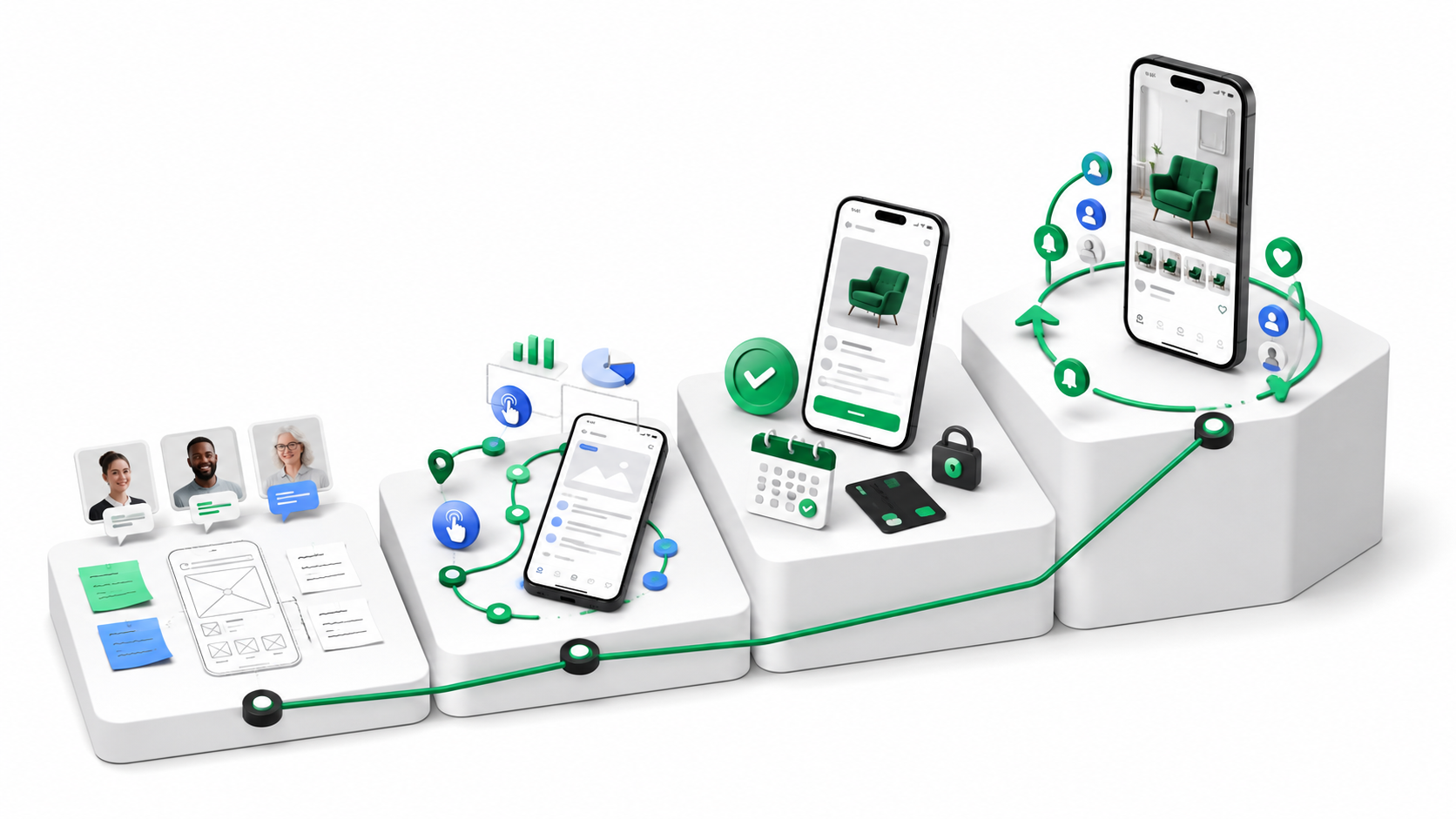
A practical validation process moves through four levels of evidence:
Evidence level
What it tests
Example evidence
Conversations
Whether the problem is recognisable and important
Interviews about current behaviour and workarounds
Behaviour
Whether people take an observable action
Prototype tasks, sign-ups or requests for information
Commitment
Whether someone is willing to give something meaningful
Time, money, access, data, introduction or a defined next step
Repeated use
Whether the solution continues to matter
Return behaviour, repeated workflow or ongoing engagement
A compliment is not the same as a commitment. A survey answer is not the same as a changed behaviour. A landing-page visit is not the same as a customer problem being solved.
The aim is to learn enough to decide whether to proceed, change direction, pause or stop.
Separate Enthusiasm from Evidence
People are often positive when they hear a new idea. They may want to encourage the founder, imagine themselves using it in theory or agree that the problem sounds interesting.
Build with FlutterCraft
Get practical startup guidance
Receive FlutterCraft guidance on validation, MVPs, product scope and digital investment.
Muhammad Yaseen is the Founder of FlutterCraft. He writes for founders and business leaders making high-stakes decisions about MVPs, digital investment, development partners, product validation, and sustainable growth.
Related articles
Continue with more FlutterCraft thinking for founders and product teams.
That feedback can be useful, but it is not enough to commission an app.
Ask:
Does the person experience the problem?
How often does it occur?
What do they do today?
What does the current workaround cost them?
What have they already tried?
What would make them change?
What action would they take next?
The GOV.UK guidance on user research in discovery recommends learning who users are, what they are trying to do, how they do it now and what problems they experience before planning, designing or building a service.
That principle applies to commercial products too. Start with the problem and the existing behaviour, not the feature list.
Define the Audience and Problem
Before speaking to users, write a short problem statement.
Question
What to define
Who is the user?
A specific group with a relevant context, not “everyone”
What triggers the problem?
The situation that causes the person to seek a solution
What are they trying to achieve?
The outcome in their own terms
What happens today?
Existing tools, manual processes, workarounds or avoidance
What is difficult?
Time, cost, risk, uncertainty, access or frustration
Why might an app help?
The capability that could improve the current situation
What must be true?
The assumptions that could make the idea viable
What would disprove the idea?
Evidence that would justify changing or stopping
A useful user need describes the person’s problem rather than prescribing a solution.
For example:
I need to compare suitable providers in one place so that I can make a confident decision without repeating the same research.
That is more useful than:
I need a mobile app with a provider directory.
The first statement can be tested through interviews and observation. The second already assumes the solution.
Conduct Interviews Without Pitching
Interviews are for learning, not persuading.
The GOV.UK guidance on in-depth interviews recommends using interviews to understand people’s circumstances, how they use services and what they need to achieve the right outcome.
Useful questions include:
Tell me about the last time you had this problem.
What were you trying to achieve?
What did you do first?
Which tools, people or processes did you use?
What was difficult or time-consuming?
What happened when the workaround failed?
Have you paid for or tried another solution?
What would make you change your current approach?
Who else would be involved in the decision?
What would you need to trust a new solution?
Avoid leading questions such as:
Would you download this app?
Do you like this feature?
Would you pay £X for it?
Would reminders make this easier?
Do you think this is a good idea?
Those questions invite polite agreement. Asking about recent behaviour is more useful.
Do not treat every interview statement as a fact. Record what was directly observed or said, then separate your interpretation from the evidence.
Look for Patterns, Not One Perfect Quote
Early research can be messy. People describe the same problem differently. Some use different language. Some have unusual circumstances. Some are not actually part of the intended audience.
After interviews, group findings by:
Repeated problem
Current workaround
Trigger
Consequence
User type
Frequency or urgency
Existing spend or effort
Decision-maker
Barrier to adoption
Evidence that contradicts the initial assumption
Do not select only the comments that support the idea.
A useful research summary contains:
Finding
Evidence
Confidence
Product implication
Users struggle to compare options
Similar descriptions of repeated research work
Medium or high, depending on the research
Explore comparison as a core journey
Users already have an effective workaround
Existing process is fast and trusted
High if repeatedly observed
Reconsider the value proposition
The buyer is different from the user
Approval or payment belongs to another role
Medium until confirmed
Include the buyer’s needs in validation
The problem occurs only in a narrow context
Behaviour appears in one specific situation
Medium
Narrow the first audience or use case
Users like the concept but do not act
Positive comments without follow-through
High if the pattern repeats
Do not treat interest as demand
Validation is stronger when it exposes inconvenient evidence early.
Test Behaviour With a Prototype or Manual Service
Once the problem is clearer, test the proposed workflow without immediately building the full app.
Possible formats include:
A clickable prototype
A landing page with a clear action
A manual service delivered behind a simple interface
A spreadsheet or form that simulates the workflow
A concierge process where the team completes difficult steps manually
A technical proof of concept for a risky integration
A small invitation-only test
The GOV.UK prototyping guidance recommends using prototypes to explore, share and test designs before committing to production code.
Choose the lightest test that can answer the question.
Uncertainty
Suitable test
Do users understand the problem?
Interview and problem walkthrough
Can users complete the proposed journey?
Clickable prototype and moderated usability test
Will people request access?
Landing page with a clear sign-up or enquiry action
Will a workflow produce value?
Manual or concierge version of the service
Can systems connect reliably?
Technical proof of concept
Will a buyer approve the purchase?
Real commercial conversation with the decision-maker
Can the product be used repeatedly?
Controlled pilot with an agreed follow-up process
Do not make a prototype look more complete than the evidence supports. The purpose is to answer a question, not to create a polished advertisement.
Look for Commitment, Not Compliments
Commitment can take different forms depending on the product and audience.
Examples include:
Agreeing to a research session
Sharing access to a relevant workflow
Introducing the decision-maker
Providing realistic test data with appropriate safeguards
Joining a pilot
Signing up for a waitlist with a clear use case
Paying a deposit or pre-ordering where appropriate
Returning to complete another meaningful task
Allowing the team to observe the existing process
Making time for implementation or procurement discussion
The form of commitment matters. A casual email address may show interest, but it does not necessarily show urgency. A completed workflow, repeated use or commercial next step provides stronger evidence.
Do not manipulate people into commitment or create artificial scarcity. Explain what participation involves, collect only the information required and make it easy to withdraw.
For research involving people, the team should consider informed consent, participant privacy and how recordings or notes will be handled. The GOV.UK research guidance includes resources for getting informed consent and managing research data.
Test the Workflow Before the Features
An app idea may sound valuable because of its feature list. Validation should examine the full workflow around the feature.
Ask:
How does the user discover the product?
What information do they need before starting?
What must they provide?
What happens if the data is incomplete?
Is another person involved?
Does the user need to wait?
What happens after the main action?
What support is needed?
What happens when the service fails?
How often would the user return?
A solution can pass a feature test and still fail as a product because the surrounding process is too difficult.
For example, a person may want an easier way to submit information, but the real barrier may be finding the correct information, receiving approval from another person or understanding what happens after submission.
Test the journey from trigger to outcome.
Use a Validation Scorecard
A scorecard helps the team make a decision without allowing one exciting result to dominate the evidence.
Area
Evidence to collect
Current confidence
Next decision
Problem
Recent examples and current workarounds
Low, medium or high
Continue research or define the problem more narrowly
Audience
Evidence that the intended group experiences the problem
Low, medium or high
Refine the first audience
Urgency
Consequences of leaving the problem unsolved
Low, medium or high
Test a stronger or different value proposition
Workflow
Ability to complete the proposed journey
Low, medium or high
Prototype or redesign the flow
Demand
Observable actions beyond positive feedback
Low, medium or high
Run a commitment test
Commercial model
Evidence that someone can approve or pay
Low, medium or high
Speak to the buyer or revise the model
Technical feasibility
Evidence about the riskiest technical dependency
Low, medium or high
Run a proof of concept or change scope
Repeat use
Evidence that the problem returns or the product remains useful
Low, medium or high
Run a controlled pilot
Risk
Privacy, safety, security or operational concerns
Low, medium or high
Obtain specialist advice before proceeding
The labels are not scientific measurements. They are a way to make uncertainty visible.
Decide: Proceed, Change, Pause or Stop
Validation should end with a decision.
Decision
When it may be appropriate
Proceed
The problem, audience and first workflow are sufficiently clear, and the riskiest assumptions have evidence
Change
The problem is real but the audience, workflow, proposition or business model needs adjustment
Pause
The idea may be valuable, but an important dependency or decision-maker is unavailable
Stop
The problem is weak, the workaround is already effective, demand is absent or the risks are disproportionate
Stopping is not wasted work. The GOV.UK discovery guidance recognises that research may show that moving forward is not the best decision. Learning this before a major build can protect time and capital.
Do not continue simply because research has already consumed money. The next question is whether further evidence is likely to change the decision.
What to Do Before Commissioning Development
Before requesting an app proposal, prepare:
A defined first audience
A clear problem statement
Evidence from current or likely users
A mapped core workflow
A list of assumptions
The riskiest assumption
A proposed validation test
A clear first-release outcome
Known privacy, security and operational considerations
A decision about what evidence would justify development
A development partner should be able to challenge the scope. If the brief treats every idea as essential, validation has not finished.
Speak to people about recent behaviour. Understand current workarounds. Test the workflow with the lightest credible method. Look for commitment and repeat use rather than compliments. Record contradictory evidence and make a clear proceed, change, pause or stop decision.
The best outcome of validation is not always permission to build. It is a better decision.
For more practical guidance on MVPs, product discovery and digital investment, visit the FlutterCraft blog or join the newsletter at /newsletter.
A practical guide for international technology companies choosing UK partners for trust, distribution, integration or delivery, with a focused thesis and measurable first motion.


 Muhammad YaseenFounder