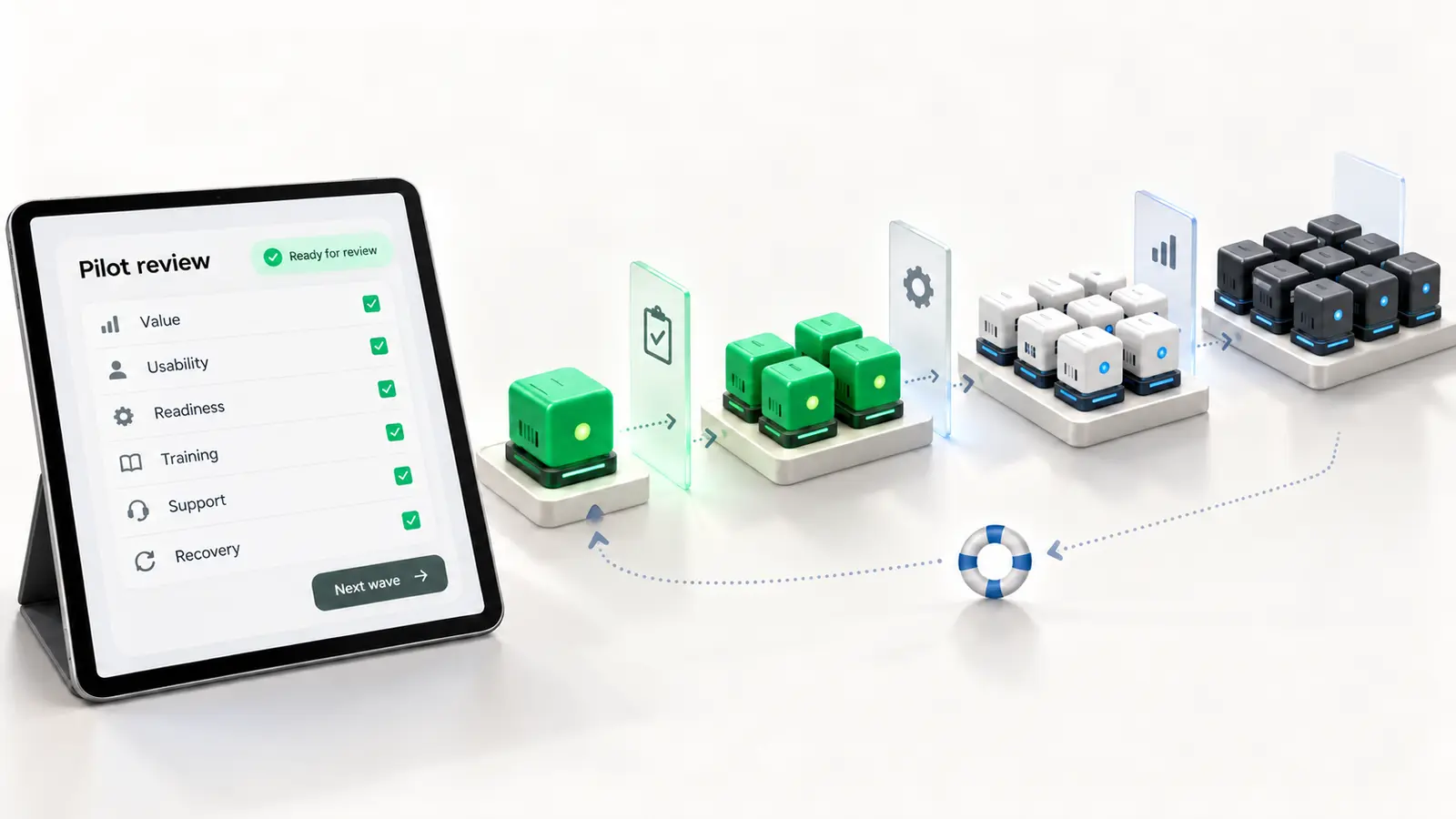
A digital pilot is ready to scale when the evidence supports a specific expansion: the intended users gain value, the workflow works with normal staffing, the technology and controls are adequate, and the organisation can support and recover the service. A successful demonstration or enthusiastic first team does not settle those questions.
For UK business sponsors and product leaders, a useful pilot to rollout strategy starts by defining the decision the trial must enable. It then tests the conditions that would make a wider rollout worthwhile, including the possibility of stopping.
This guide provides a practical planning framework for that decision. It is general delivery guidance, not a guarantee of uninterrupted service or a substitute for sector-specific assurance, security assessment or legal advice.
Define the expansion decision before the pilot
Write the proposed decision in concrete terms: “Should we introduce the new work-order intake process across three further branches, with the existing operations team supporting it?” That statement identifies the change, the next population and the operating assumption to test.
Distinguish what the pilot can establish from what it cannot. A trial in one well-connected office may reveal whether the interface is understandable. It cannot establish performance at a rural site with unreliable connectivity unless that condition is tested.
HM Treasury's Test and Learn guidance recommends agreeing decision criteria before testing and recording changes to the intervention. Although written for government, this is a useful discipline for a business pilot: keep the original questions visible and explain any change to the test.
Agree who makes the final decision, who supplies the evidence and who can pause the trial. Include an operations representative alongside the sponsor and delivery team. Place the initiative within your wider digital transformation roadmap, so an isolated success does not create an unsupported service.
Put the pilot agreement on one page
Use a short charter that a sponsor, team member and support colleague can all understand. Detailed technical plans can sit behind it.
| Charter field | What to record |
|---|
| Decision | The specific expansion, investment or operating change being considered |
| Intended benefit | The user or business outcome, its owner and how it will be observed |
| Baseline | Current performance, measurement method and known weaknesses in the data |
| Scope | Included journeys, integrations and data; explicit exclusions |
| Cohort | Participating roles and sites, selection reasons and important gaps |
| Duration | Time needed to observe relevant work, plus the review date and budget limit |
| Success criteria | Evidence required across value, usability, feasibility, risk and repeatability |
| Operating model | Staff, training, support, supplier responsibilities and recurring cost assumptions |
| Stop and recovery | Pause triggers, decision authority and a workable fallback |
| Decision record | Where findings, exceptions, changes and the final rationale will be kept |
Set duration around the activity being tested. A fortnight may include many support requests but no monthly reconciliation. Record the missing cycle explicitly rather than presenting the calendar end date as evidence of readiness.
Keep the pilot bounded without making it artificial. Narrowing the number of users can be sensible; removing every difficult case leaves a different process from the one you intend to introduce.
Test five conditions for repeatable value
The following framework is a proposed planning aid. It is not a validated scoring standard or a universal approval checklist. Agree appropriate evidence and thresholds for your own initiative before running the trial.
| Condition | Question to answer | Useful evidence |
|---|
| Value | Does the complete workflow improve an outcome that matters? | Time, quality or customer outcome compared with a credible baseline |
| Usability and adoption | Can intended users complete the task and return to it? | Observed task completion, repeat use, failures and reasons for avoidance |
| Technical feasibility | Can the system work with the intended integrations, devices and demand? | Representative end-to-end tests, data checks and operating observations |
| Risk | Are permissions, sensitive data, errors and recovery acceptably controlled? | Tested controls, unresolved issues and accountable risk decisions |
| Repeatability | Can the next team achieve the result with the planned resources? | A second context, normal support effort and documented dependencies |
Treat a serious unresolved risk as a separate blocker. An attractive benefit should not average away unauthorised access or an untested recovery path.
Record adoption alongside usability. People may complete a supervised task and still avoid the tool during normal work because it interrupts a handover, duplicates another system or lacks a necessary exception. Ask why; a login count will not explain the problem.
If the initiative involves AI, the practical AI adoption guide adds questions about output quality, oversight and data readiness. Keep those requirements inside the pilot's acceptance conditions.
Establish a baseline and test the next population
Measure the current process before the trial where possible. Specify what starts and ends a task, how incomplete cases are counted and which quality failures matter. Use the same definitions during the pilot.
If the pilot has already finished, reconstruct the comparison from reliable existing records where you can. Explain gaps, changes in measurement and differences between the groups. Do not invent a baseline or present criteria chosen after seeing the results as criteria agreed beforehand. You may need a further bounded test to resolve the missing evidence. That limitation belongs in the recommendation, particularly when the next decision commits substantial spending or affects many users.
The Magenta Book's evaluation guidance explains why baseline and comparison data need early planning and why observed change needs interpretation. Its government evaluation methods require proportionate adaptation; a small business trial is not automatically a causal study.
Look for alternative explanations. Quieter demand, additional staff, easier cases or a simultaneous policy change could affect the result. Where practical, compare similar work handled through the existing process during the same period. If a credible comparison is unavailable, describe the result as indicative and keep the uncertainty in the decision record.
Choose participants deliberately. Include relevant roles, locations, experience levels, accessibility needs and technical conditions. You need not represent everyone immediately, but you should know who has not been tested and make that gap part of the next wave.
Use enough activity to judge the decision at hand. Google's guidance on canary releases links meaningful evaluation to representative traffic, observation time and attributable metrics. For a business pilot, apply the same caution to a quiet dashboard: few problems may simply mean few opportunities for the process to fail.
Ask for evaluation expertise when the consequence of a wrong decision warrants stronger evidence. Avoid inventing a universal minimum participant count or treating absence of complaints as proof of success.
Expose the operational work hidden by the trial
Keep an effort log alongside the outcome dashboard. Record data cleaning, manual fixes, repeated explanations, supplier assistance, exception handling and work performed outside the new system. Distinguish one-off setup from work that will continue as usage grows.
Consider an illustrative work-order pilot. The old process takes twelve minutes per request across entry, correction and reconciliation. In the pilot, staff spend eight minutes on entry, but a specialist spends another five minutes correcting and reconciling each new record. Across the same workflow boundary, total effort is thirteen minutes rather than twelve. Recurring support is excluded consistently from both figures and must be assessed separately. The apparent four-minute saving becomes one additional minute. This is hypothetical arithmetic, not a client result or industry benchmark.
That finding does not decide the whole business case: accuracy or customer response may still have improved. It does mean the sponsor must assess the complete workflow and explain which benefit justifies the extra work.
The government's research on technology adoption among UK SMEs highlights the value businesses place on reliable, personalised support. Budget that support explicitly. Do not assume that patient help from the pilot team will be available across every branch indefinitely.
Run a handover test. Give a colleague who did not build the solution the documentation and agreed training, then observe a normal task and a difficult exception. If the workflow still depends on the original specialist quietly repairing outcomes, repeatability remains unproven.
Choose stop, iterate, extend or roll out
Review the evidence against the criteria agreed in the charter. Separate a weak result from an incomplete test, and record disagreements instead of turning them into a vague “mostly successful” verdict.
| Decision | When it is justified | Required next step |
|---|
| Stop | The problem is not worth solving this way, or an unacceptable issue has no credible resolution | Close access safely, preserve required records and capture the learning |
| Iterate | A specific change could address an identified failure | State the hypothesis, revise the process and retest affected criteria |
| Extend | A defined evidence gap remains, such as an unobserved cycle or missing cohort | Limit additional time and spending; specify the evidence and decision date |
| Roll out | The proposed next wave has sufficient evidence, ownership and operational readiness | Authorise that wave, its controls and its review checkpoint |
Extend the pilot to answer a named question. Additional time alone will not repair an unsuitable measure or an unrepresentative cohort.
Write the decision with its conditions: who approved it, which evidence was used, what remains uncertain and what would reverse it. A supplier's successful demonstration can be one input; the business still owns the decision about its customers, staff and budget.
Expand through controlled waves
Define waves around meaningful operating differences: another role, branch, customer group or integration. Avoid enlarging the group and changing several important conditions simultaneously when you need to understand which change affected the result.
For each wave, name its owner, entry conditions, training arrangements, support coverage, monitoring period and stop authority. Agree the handover between pilot staff and the people who will run the service routinely.
The Government Service Manual's beta guidance starts with limited users and stresses capacity to learn, iterate and support people who struggle. It is public-service guidance rather than a mandatory SME process, but its operational emphasis is useful when planning expansion.
Check readiness before adding users: staff can find instructions, administrators understand access, support can identify the affected group, and someone can respond during the working patterns the wave includes. Show users the changed task and exception route, then observe whether they can use them.
Make wider exposure conditional on evidence. Microsoft's safe deployment guidance recommends health checks between stages and recognises that recovery involving data can be complex. Monitor customer outcomes and support load as well as technical errors.
Keep expansion and recovery distinct. Pausing the next wave limits additional exposure; it does not repair an incorrect record or reverse a payment. Disabling a feature, reverting application code, restoring data and correcting affected transactions require different actions. Shared infrastructure may still affect people outside the visible rollout group.
Before an irreversible data change, agree and rehearse the feasible recovery method. Establish how records created during the change will be preserved or reconciled and who accepts any remaining interruption or data-loss risk. An old backup is not, by itself, evidence that the current business state can be recovered safely.
Use the detailed SaaS release planning guide for customer communication, compatibility and release controls. The sponsor's rollout decision should refer to that evidence rather than duplicate the engineering runbook.
Review benefits at 30, 60 and 90 days
Keep the outcome owner accountable after expansion. The following timetable is a suggested management cadence, not a research benchmark. Start it from the agreed production milestone and adapt it to the workflow's actual benefit cycle.
| Review | Main question | Evidence and decision |
|---|
| 30 days | Can people use and support the changed process? | Review completion, recurring errors, support effort and training gaps; stabilise before expanding further |
| 60 days | Does value persist beyond the first enthusiastic group? | Compare cohorts and normal workload; check ongoing costs and exceptions; adjust scope or operating support |
| 90 days | Are the intended benefits credible and sustainable? | Review outcomes against baseline, uncertainty and total cost; continue, revise, consolidate or retire |
Keep claimed benefit separate from cash released. Faster work may create capacity for better service without reducing payroll. State what the business has done with that capacity and avoid counting the same improvement twice.
Review who is missing from the results. Average performance can conceal a group that needs more assistance or repeatedly abandons the process. Give unresolved issues owners and dates, and retain a route for staff and customers to report problems.
Finish each review with a decision and the evidence needed next. A rollout remains a business change to manage after the delivery project closes.
Make the next commitment reviewable
Before approving expansion, ask for the one-page charter, results across the five conditions, the operational effort log and the proposed next-wave plan. Unanswered questions should become specific work with an owner, a cost limit and a decision date.
If the evidence supports only a limited step, authorise that step. If it supports stopping, retain the learning and release the remaining budget. For help making that decision concrete, design a pilot that supports a real rollout decision with FlutterCraft.
Evidence checked: 30 October 2026. Review by: 28 January 2027, or sooner after material changes to guidance or the operating environment.


 Hassan KhanHead of Strategy & Partnerships30 Oct 202611 min read00