The strongest software-development partner is not necessarily the one with the largest portfolio, the lowest estimate or the most polished sales presentation.
A suitable partner should demonstrate good judgement: the ability to understand your outcome, challenge weak assumptions, explain trade-offs, deliver transparently and leave the business with appropriate control of its product.
This guide helps UK founders, product leaders and procurement stakeholders evaluate prospective software partners. It is educational guidance, not legal, procurement or data-protection advice.
Define the outcome before comparing suppliers
Supplier selection begins with your own clarity.
Write down:
- the business or user problem to solve;
- intended users and their important journeys;
- evidence already available;
- expected outcome and success measures;
- constraints around timing, budget, integrations, data and regulation;
- decisions already made and questions still open;
- what you expect the partner to own.
Without this, each supplier may estimate a different product while appearing to answer the same brief.
A good partner should help distinguish between a stated solution and the underlying problem. If the problem is not yet sufficiently understood, discovery may be the appropriate first engagement.
Assess relevant evidence, not generic confidence
Ask for evidence relevant to your product stage and complexity.
| Area | Useful evidence |
|---|
| Discovery | How the supplier identifies assumptions, risks and scope boundaries |
| Product judgement | Examples of trade-offs, alternatives or difficult decisions it can explain |
| Delivery | Clear roles, milestones, reporting and change-control approach |
| Technical quality | Architecture, testing, release and maintenance practices |
| Security | Secure-development process, vulnerability handling and access controls |
| Ownership | Repository, cloud-account, documentation and handover approach |
| Support | Post-launch maintenance, monitoring, support and escalation model |
| Commercial clarity | Assumptions, exclusions, dependencies and payment structure |
Do not expect confidential client material. A credible supplier can explain methods, provide permitted examples and be honest about its limits.
Judge the questions the partner asks
A strong partner asks questions before making promises.
Useful questions include:
- Which user or business outcome matters most?
- What evidence supports the proposed solution?
- Which assumptions could most affect time, cost or product value?
- What needs validating before a full build commitment?
- Which integrations, data flows or constraints carry material risk?
- Which work is essential for the first release and what can be deferred?
- What would make the supplier recommend a different route?
Be cautious if a supplier offers precise certainty from a vague brief, avoids uncomfortable trade-offs or agrees with every request without asking why.
Assess technical leadership and quality practices
A good development partner should be able to explain how it makes technical decisions without hiding behind jargon.
Ask about:
- architecture and how it supports the product’s likely evolution;
- code review, testing and release practices;
- handling of environments, credentials and production access;
- dependency management and security updates;
- incident response and support after launch;
- accessibility and device/browser testing;
- technical documentation and knowledge transfer;
- how it handles changes in scope or evidence.
The NCSC’s secure development and deployment guidance is intended to help organisations assess their own and suppliers’ software-development practices. Use it to guide proportionate questions, not as a claim that any one process guarantees a secure product.
Make security and data responsibilities explicit
If the supplier will access systems, source code, production environments or personal data, security should be part of selection and contract discussions.
The NCSC’s Software Security Code of Practice guidance for customers recommends requesting vendor assurance information and using it in supplier negotiations and security agreements.
Ask:
- Which staff and subcontractors will access sensitive systems or data?
- How are access rights granted, reviewed and removed?
- How are code repositories, secrets and deployment credentials protected?
- How are security vulnerabilities reported, prioritised and fixed?
- How are third-party dependencies assessed and maintained?
- What security evidence can the supplier provide that is proportionate to the work?
Where a supplier processes personal data on behalf of your organisation, the ICO explains that a written controller–processor contract is required, with specific terms including security measures, sub-processor arrangements and end-of-contract provisions. See the ICO’s contract guidance.
Test transparency and governance
A successful software relationship needs visible decisions.
Clarify:
- who owns product priorities;
- who has authority to approve scope changes;
- how progress, risks and blockers are reported;
- how often working software is demonstrated;
- how estimates are updated when evidence changes;
- how concerns are escalated;
- how changes are documented;
- who is responsible for stakeholder communication.
You are not looking for a partner that claims there will be no problems. You are looking for one that makes emerging problems visible early enough to manage them.
Protect ownership and exit readiness
The business should retain practical control of critical assets.
Confirm ownership and access for:
- source-code repositories;
- cloud accounts and production environments;
- app-store listings and domains;
- databases and backups;
- third-party subscriptions;
- technical documentation;
- deployment processes;
- user and administrator accounts.
Government procurement guidance stresses explicit ownership of technology-service data and intellectual property, including software code and business rules. It also highlights the value of planning exit and transition arrangements. See GOV.UK’s Digital, Data and Technology Playbook.
A clear exit plan is a sign of a mature partnership, not a lack of trust.
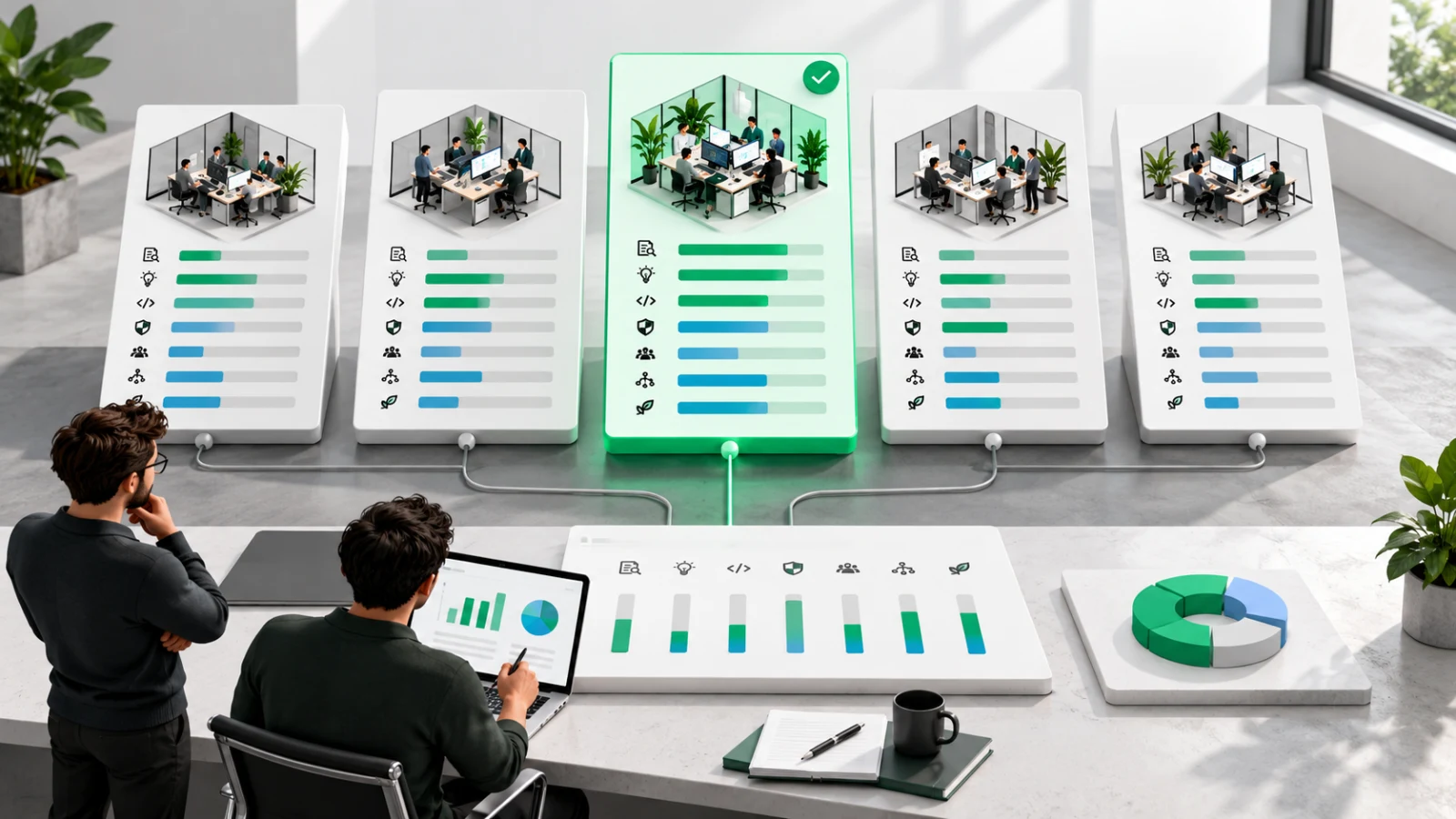
Use a weighted scorecard
Score shortlisted suppliers against the same evidence.
| Criterion | Weight | What strong evidence looks like |
|---|
| Discovery and product judgement | 20 | Understands outcomes, challenges weak assumptions and identifies useful next decisions |
| Relevant delivery capability | 15 | Demonstrates appropriate technical and operational experience |
| Technical quality and security | 15 | Explains testing, secure development, release and maintenance practices |
| Team and governance | 15 | Names roles, communication rhythm and escalation path |
| Ownership and continuity | 15 | Provides clear access, documentation, handover and exit arrangements |
| Commercial transparency | 10 | States assumptions, exclusions, dependencies and change process |
| Support and long-term fit | 10 | Offers a realistic model for maintenance, improvement and transition |
Use the score to structure discussion, not replace judgement. A supplier may score differently depending on whether you need a short discovery engagement, a full product build or long-term support.
Questions for reference calls
If you speak with a supplier’s references, ask focused questions:
- What did the supplier do when the scope changed?
- How visible were risks, progress and decisions?
- Did the team challenge assumptions constructively?
- Did you retain access to code, infrastructure and documentation?
- How did the supplier handle defects, urgent issues or post-launch support?
- Would you understand how to transition away if needed?
- What would you do differently before starting again?
Avoid asking only, “Were they good?” Specific questions produce more useful evidence.
Watch for red flags
A red flag is not always an automatic rejection, but it should prompt further evidence.
Examples include:
- a detailed fixed price based on a vague or incomplete brief;
- no named delivery team or technical leadership;
- vague answers about security, testing or data;
- no clear ownership or handover model;
- pressure to use supplier-controlled accounts without business access;
- no documented approach to change control;
- broad marketing claims without evidence;
- reluctance to discuss exit, support or limitations.
The partner should be comfortable being assessed. Serious buyers should be comfortable asking difficult questions.
Conclusion
The best software-development partner is selected through evidence, judgement and working fit.
Look for a team that understands the problem before prescribing a solution, makes risks visible, explains trade-offs and supports practical ownership of the product. Assess technical quality, security, governance, support and exit readiness alongside the commercial proposal.
A polished presentation can start a conversation. Transparent delivery capability should decide the shortlist.
Sources and further reading


 Hassan KhanHead of Strategy & Partnerships24 Oct 20267 min read00