A useful product brief tells developers who needs help, what outcome matters, what the first release must achieve and which constraints or questions could change the plan. Start with one page, link the supporting evidence and label anything you have not confirmed.
For UK founders approaching a product or engineering team, that is enough to start a focused conversation. You do not need to settle every screen, database choice or technical requirement before asking for help. You do need to make your business decisions and uncertainties visible.
The product brief template below is designed for that first conversation. Complex, regulated or safety-critical products will need more detailed discovery and specialist review before delivery commitments.
Define the decision your brief should support
Write down what you want the receiving team to do next: assess feasibility, propose discovery, compare approaches or estimate a defined release. These are different requests. A preliminary estimate built around unresolved assumptions should be understood differently from a delivery commitment based on agreed scope.
Treat the brief as a shared starting point that develops with evidence. Detailed requirements, acceptance criteria and technical designs can follow when the team understands the problem.
Atlassian's product requirements guidance includes assumptions, open questions and explicit exclusions alongside goals and user stories. It also recommends collaboration and keeping requirements current. A founder's initial brief can use that discipline at a smaller scale, without becoming a full product requirements document.
Name the business owner, the person who answers day-to-day questions and the decision the team is being asked to support. Put a version and review date at the top so everyone can identify the current brief.
Connect the business outcome to success evidence
Describe the change you want in a user's work or your business operation. “Launch an app” describes a deliverable. Explain what would make that app worth operating.
For example, you might want customers to book an available course without staff checking several spreadsheets. Useful evidence could include completed bookings, staff intervention and booking errors. Choose measures that relate to the problem, rather than selecting impressive-looking download targets.
Separate what you know from what you hope to achieve. If you have no reliable baseline for staff time, say so and assign someone to measure it. Do not invent a reduction target merely to fill the template.
Add why this matters now: an operational bottleneck, a customer commitment or a business opportunity. Explain who will decide whether the first release is useful enough to continue investing in.
If the decision is still whether to build a working product at all, first consider the right scope for an MVP or fuller product.
Describe users, their context and their current workaround
“Our customers” is rarely specific enough to guide a first design discussion. Identify the initial group, the task they need to complete and where they encounter difficulty.
Include the people who operate the service. A customer-facing booking journey may depend on staff correcting records, answering questions or managing exceptions. Explain those activities even if the interface will initially remain manual.
The GOV.UK guidance on learning about user needs recommends investigating what people are trying to do, how they currently do it and the problems they encounter. It distinguishes evidence from assumptions and connects needs with later user stories. Those research principles are useful beyond government services.
Link relevant interview summaries, support themes or process observations. Include their date, who gathered them and their limitations. A handful of conversations can suggest questions to investigate; do not present it as proof that an entire market wants your proposed solution.
Bound the first release with complete journeys
Describe a small number of essential journeys from trigger to outcome. A journey might be: find an available course, choose a session, submit required details and receive confirmation.
Then identify important exceptions. What happens when the last place is taken during booking? Who handles a cancellation? What can staff correct? You can record an unresolved rule without designing its answer immediately.
State explicit non-goals beside the journeys. For a first release, these might include membership subscriptions, corporate account billing or a second language. Exclusions explain the current boundary; they do not mean the capability will never matter.
Distinguish essential behaviour from a preferred solution. If users need access while travelling, describe their devices, connectivity and task context before deciding that separate native apps are necessary. If a platform is a real constraint, record the reason rather than hiding it as a design preference.
Expose constraints that could change the work
Give the team enough information to challenge feasibility and scope. Use the following prompts to avoid hiding material dependencies behind “standard integration” or “simple admin”.
| Constraint | What to include in the brief |
|---|
| Existing systems | System owner, available documentation, access status and whether integration capability has been verified |
| Data | What must be collected or migrated, where it comes from, who owns it and known quality problems |
| Users and devices | Required platforms, accessibility needs, languages and connectivity conditions |
| Timing | Any fixed event or contractual date, the reason it matters and what can move |
| Budget | Approved spending boundary or planning range, what it covers and who can authorise changes |
| Operations | Who supplies content, supports users, maintains the service and approves business rules |
For personal information, identify the processing early. The ICO's data protection by design guidance requires appropriate measures from design throughout the lifecycle. A brief should surface the data and questions requiring review; writing “GDPR compliant” does not define the work. Establish applicable legal, security and accessibility requirements with appropriate specialists. This template is not a compliance assessment or legal advice.
Be clear whether your budget includes discovery, implementation, third-party services and ongoing support. If it is still a planning assumption, label it. For the subsequent funding discussion, use the framework for controlling software-project budget changes.
Give important unknowns an owner and a next step
An honest unknown is useful when the team can act on it. “We assume the booking system has an API” should become a question with an owner, a way to verify it and a decision deadline.
For each material assumption, record what would change if it proved false. An unavailable integration might alter the workflow, release scope or supplier choice. That makes the question easier to prioritise than a general request to “research the technology”.
GOV.UK discovery guidance recommends exploring constraints and risky assumptions before moving further into delivery. Apply that principle proportionately: investigate the uncertainties that could change the investment decision first.
Mark entries as confirmed, assumed or open. Reserve “confirmed” for information supported by an identified source or an accountable decision.
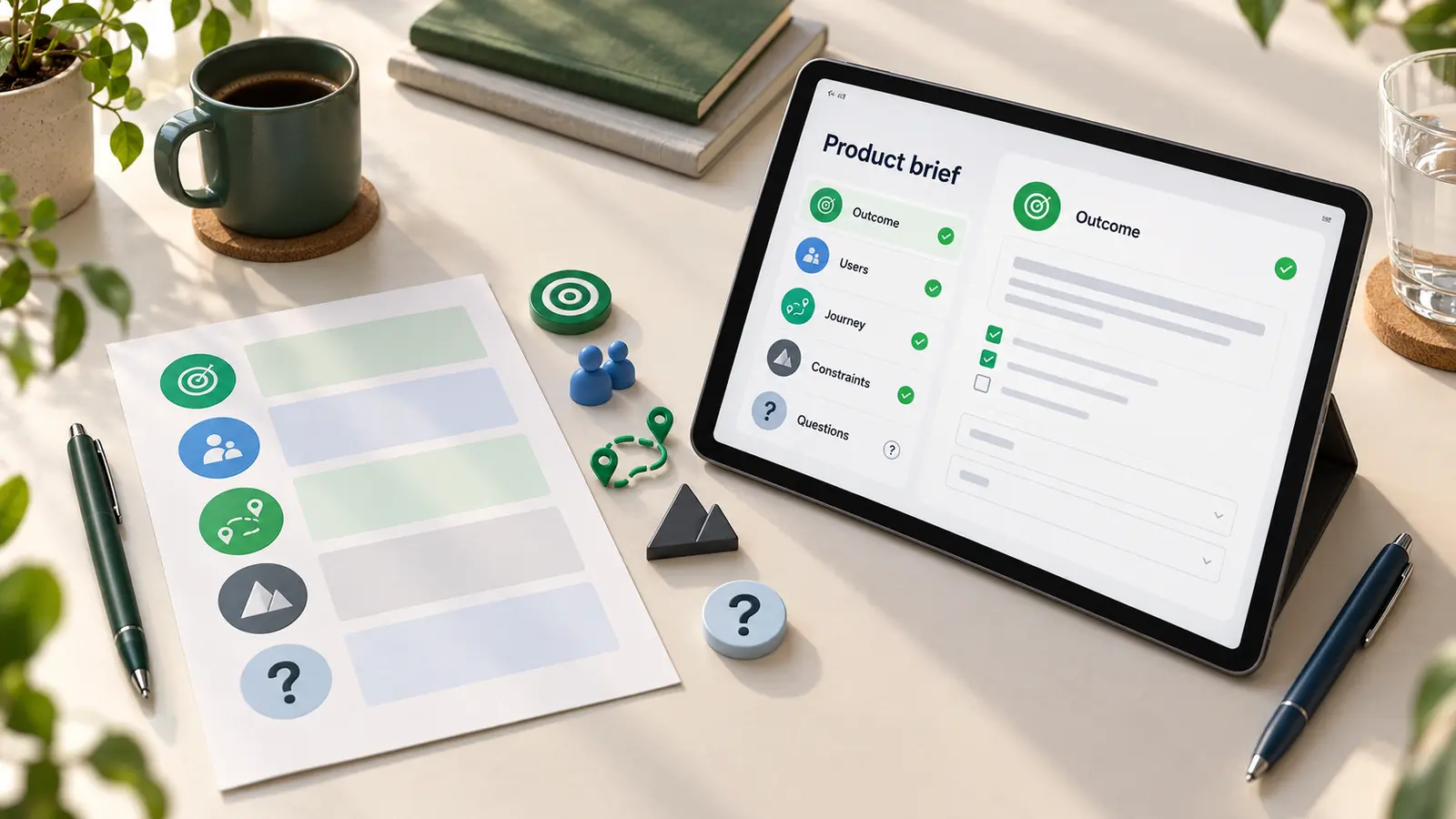
Copy this one-page product brief template
Keep each answer short and link detailed material. If an answer is unknown, say so and identify the next question. The page should remain readable without opening every attachment.
PRODUCT / INITIATIVE:
Owner: [name] | Version/date: [details]
Decision requested: [feasibility, discovery, options or estimate]

1. OUTCOME AND WHY NOW
Help [user group] achieve [result] because [business reason].
Success evidence: [measure, baseline or plan to establish it].

2. USERS AND CURRENT PROCESS
Initial users: [specific group and context].
Current workaround: [steps, friction and supporting evidence].
Staff/support roles: [who else must make the service work].

3. FIRST-RELEASE JOURNEYS
Essential journeys: [trigger → main steps → useful outcome].
Important exceptions: [failure, cancellation or correction].

4. BOUNDARIES
In scope: [minimum behaviours and operating needs].
Out of scope: [explicit non-goals for this release].

5. CONSTRAINTS AND DEPENDENCIES
Systems/data/access: [confirmed details and owners].
Platforms, accessibility, privacy/security: [needs or reviews].
Timing: [date, reason, flexibility].
Budget: [approved limit or assumption; inclusions/exclusions].

6. UNKNOWNS AND EVIDENCE
Question | status | consequence if wrong | owner | next test/date.
Evidence links: [research, process map, system documentation].

7. DECISIONS AND NEXT STEP
Decision-maker: [name] | Day-to-day contact: [name].
What we need from the team: [specific response or workshop].
Next review: [date and decision to make].
This is a proposed working structure, so adapt the headings to the product. Keep specialist requirements and detailed research in linked documents when one page cannot represent them responsibly.
A weak brief and a stronger alternative
Both examples below are hypothetical. They illustrate how information changes the conversation; they do not describe a FlutterCraft client or measured business result.
Weak example
“We need an app like a leading booking platform, with payments, dashboards and notifications. It must be easy to use, scalable and ready quickly. Please send a fixed quote.”
The team would have to guess who books, how availability works, which payments are needed, what “quickly” means and what the first release excludes.
Stronger example
Purpose: Help adult learners book public training sessions without staff confirming places by email. The first discussion should determine feasibility and the work needed before estimating delivery.
Users and evidence: Begin with individuals booking for themselves. The operations lead will provide a redacted current-process map. Customer interviews and the baseline for manual intervention are still open tasks.
Core journey: Choose a course and session, supply required details, request a place and receive the appropriate confirmation. Staff need to maintain session availability and handle cancellations. The rule for simultaneous requests for the final place requires agreement.
Boundary: Corporate group bookings, subscriptions and multilingual content are outside this first release. Payment collection is an open scope decision, not silently assumed to be included.
Constraints: Existing course records remain the source of truth. API availability and access terms are unconfirmed; the operations lead will obtain documentation before the feasibility discussion. Device and accessibility needs require user research. The sponsor will confirm a planning budget and explain any date constraint.
Next step: Review the workflow, identify integration and data risks, and propose the smallest investigation needed to compare delivery options.
This version still contains unanswered questions. It gives the team enough context to explain which answers matter, who needs to provide them and what can sensibly be estimated next.
Review the brief together before requesting commitment
Ask the team to describe the user, outcome and release boundary back to you. Differences in interpretation reveal where the brief needs work. Then agree the questions that block a meaningful estimate and those that can be resolved during delivery.
Keep one current version, record important changes and notify the people affected. A newly added payment flow or integration deserves an explicit scope discussion.
Use a focused product discovery sprint when important assumptions need testing before committing to implementation. The brief becomes its input, with a clear decision expected at the end.
Turn your brief into a discovery plan
Complete the template, mark the unresolved questions and choose the decision you need next. Bring the same version to every prospective delivery team so differences in advice are easier to understand.
For help reviewing the scope and choosing useful next investigations, discuss your product brief with FlutterCraft.
Sources checked: 30 October 2026. Review the privacy guidance by 28 January 2027 and the full framework by 28 April 2027.


 Muhammad YaseenFounder30 Oct 20269 min read00