The Product Discovery Sprint: A Practical Guide for UK Teams
Run a focused product discovery sprint to clarify outcomes, users, risks, options, feasibility and the evidence needed before software delivery.
Mubeen AhmadCo-Founder
28 Aug 202610 min read81
On this page
The Short Answer
A product discovery sprint is a focused period for reducing uncertainty before a team commits to software delivery.
It should help answer:
Who is the product for?
What problem matters most?
What outcome should the product create?
How do people solve the problem today?
Which assumptions are most dangerous?
What solution options are realistic?
Which technical or operational constraints matter?
What should be tested before development?
What should the first release include?
Should the team proceed, change direction or stop?
A five-day sprint can create a strong decision package, but it is not a promise that every product is fully understood in five calendar days. The right duration depends on the problem, users, risk and evidence already available.
The GOV.UK discovery guidance makes the same broader point: discovery should understand the problem, users, constraints, opportunities and whether moving forward is worthwhile. It is also acceptable for discovery to show that a service should not proceed.
The sprint is successful when the team has better evidence and a clearer decision, not when it has produced the largest document.
What Discovery Should Decide
Start by agreeing what the sprint must make possible.
Decision area
Question
Build with FlutterCraft
Plan a focused product discovery
Turn product uncertainty into a focused discovery plan with clear research, prototype, technical and delivery outputs.
Mubeen Ahmad is Co-Founder of FlutterCraft. He writes about product discovery, UX, delivery operations, quality, analytics, accessibility, and the practical systems teams need to launch and improve digital products.
Related articles
Continue with more FlutterCraft thinking for founders and product teams.
What should the target user be able to do or achieve?
Business outcome
What business result would make the work worthwhile?
Problem
What real problem is being addressed?
Scope
What is explicitly inside and outside the first release?
Risk
Which assumption could make the product fail?
Feasibility
What technical, operational or regulatory constraints need investigation?
Evidence
What must be observed, measured or tested before proceeding?
Ownership
Who can approve the decision and act on it?
Next step
Should the team proceed, change, pause or stop?
A discovery sprint should not begin with the assumption that the requested solution is already correct.
If someone says, “We need an app for this process”, reframe the request:
What problem is the app expected to solve?
Who experiences the problem?
What happens today?
Why is the current process insufficient?
What other solutions could address the problem?
What would make the proposed app unnecessary?
This prevents the team from treating a technology request as a product conclusion.
Inputs Required Before the Sprint
A sprint becomes inefficient when participants spend the first day searching for basic context that should have been prepared beforehand.
Collect the available inputs:
Business objectives
Existing product or service information
Previous research
Analytics and support evidence
Existing process maps
Customer or user feedback
Current technical architecture
Known integrations
Security and privacy considerations
Commercial constraints
Delivery constraints
Relevant stakeholders
Decision owner
Existing ideas or proposed features
The GOV.UK guidance on planning user research recommends defining research objectives, user groups and research activities around the questions the team needs to answer.
Prepare a short briefing document with:
Briefing item
Required detail
Product context
Why the work is being considered now
Current problem
What is difficult, costly, risky or frustrating
Known users
Who is affected and what is already known
Existing evidence
Research, data, feedback or operational knowledge
Constraints
Technical, commercial, operational, security or accessibility constraints
Open questions
Decisions that cannot yet be made confidently
Sprint decision
What the team must decide at the end
The team should know what success looks like before the sprint begins.
Day 1: Outcomes, Users and Constraints
The first day creates a shared understanding.
Morning: Align on the outcome
Turn broad objectives into specific outcomes.
Instead of:
Build a customer portal.
Use:
Help existing customers complete the most important account task without contacting support.
The second statement is easier to research, prototype and measure.
Do not coach participants through the task too quickly. If the prototype is confusing, record that as evidence.
Day 4 output: Tested prototype or proof of concept, research plan, findings template and an agreed definition of useful evidence.
Day 5: Evidence Review, Scope and Decision
The final day turns findings into a delivery decision.
Review:
What was confirmed?
What was contradicted?
What remains unknown?
Which user needs are strongest?
Which assumptions remain risky?
What did the prototype reveal?
What did the technical investigation reveal?
What should the first release include?
What should be deferred?
What must be measured after launch?
Create a scope boundary.
Scope area
First release decision
Core user
Define the first user group and context
Core outcome
State the one outcome the product must support
Required journey
Include the steps, states and recovery needed for that outcome
Trust and accessibility
Include information and interaction support users need
Technical foundation
Include only the technical work required for the chosen journey
Learning
Define what the first release must help the team learn
Deferred work
Record features that are intentionally outside the first release
Future decision
State what evidence would justify expanding scope
Then choose one of four outcomes:
Decision
Meaning
Proceed
Evidence supports the next delivery phase
Change
The problem or solution needs a revised direction
Pause
A dependency or decision is not ready
Stop
Continuing would not be justified by current evidence
A stop decision can be a successful discovery outcome. It may protect users, budget and team capacity.
Day 5 output: Discovery summary, product scope, decision log, risk register, roadmap options and proceed/change/pause/stop recommendation.
Minimum Outputs Before Engineering Begins
Before development starts, the team should have:
A clear problem and outcome statement.
A defined first user group.
A mapped core journey.
A list of assumptions and risks.
Evidence from relevant users or stakeholders.
A tested prototype or technical proof of concept where needed.
A documented first-release scope.
A deferred-work list.
A technical and operational constraint summary.
A measurement and learning plan.
Named decision owners.
A clear next-step decision.
These outputs do not guarantee that delivery will be easy. They make the remaining uncertainty visible and manageable.
Common Discovery Sprint Mistakes
Avoid:
Treating a requested feature as the confirmed solution
Inviting stakeholders without a decision owner
Running workshops without user evidence
Confusing internal preference with user need
Designing every possible journey
Building production code before testing the riskiest assumption
Producing a roadmap without a scope boundary
Ignoring operations, support or accessibility
Collecting research that the team cannot act on
Declaring success because the workshop finished
Hiding contradictory evidence
Treating a five-day sprint as a substitute for all future research
Discovery should create momentum through clarity, not momentum through premature commitment.
Conclusion
A product discovery sprint is a decision-making process.
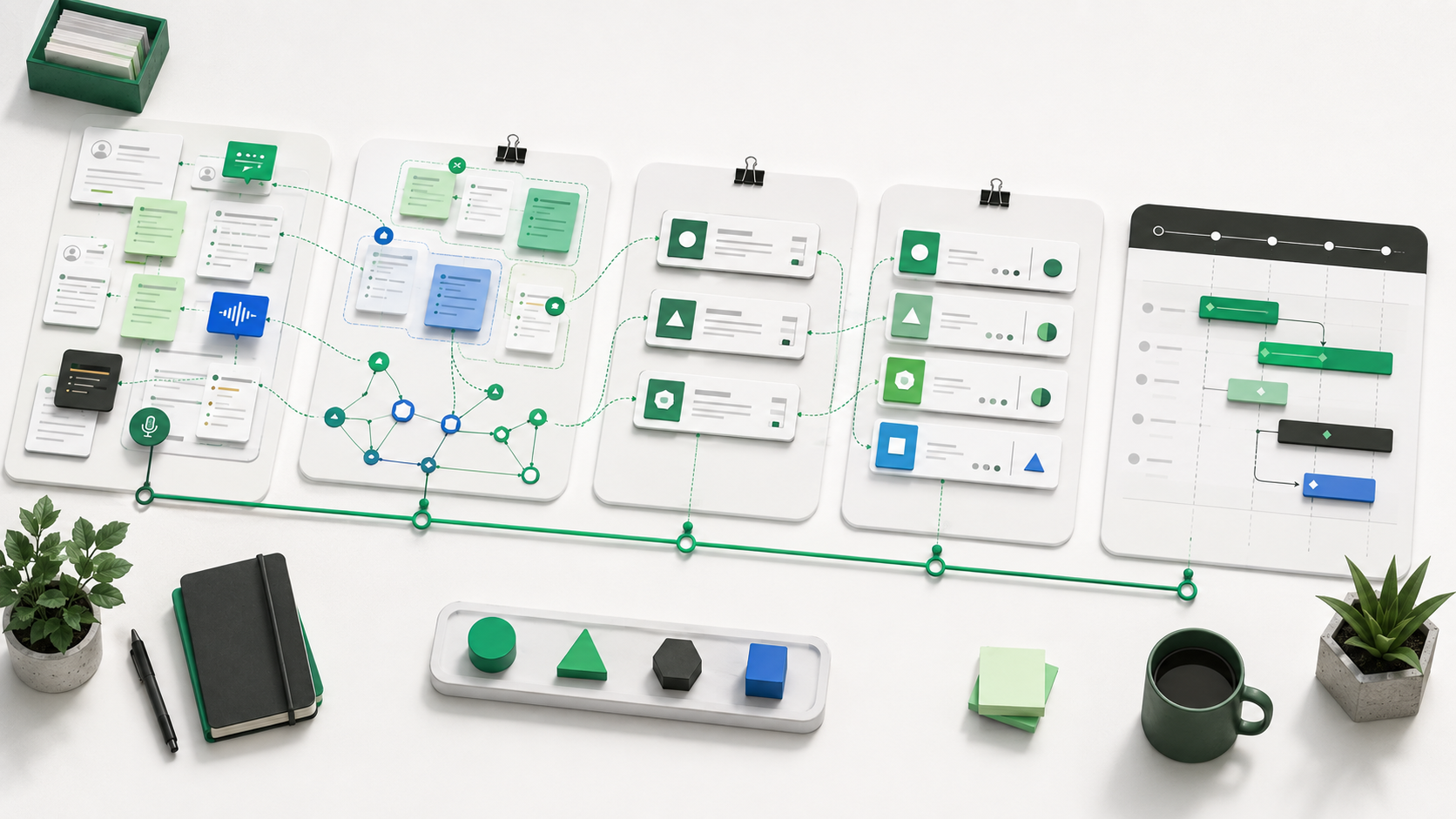
Start with the outcome and problem. Understand users and context. Map the journey. Rank assumptions. Compare solution options. Test the riskiest questions. Investigate feasibility. Finish with a scope boundary and a clear decision.
Compare Supabase and Firebase across data models, authentication, realtime, security, pricing drivers and portability before choosing a backend for your startup app.


 Mubeen AhmadCo-Founder